
Definition of Black Hat SEO
In the world of search engine optimization, there are two main approaches: the ethical one, called White Hat SEO, and the risky approach, known as Black Hat SEO.
Although this second approach may seem appealing due to its quick results, it poses a real danger to the long-term sustainability of your website.
On this page, discover a complete definition of Black Hat SEO, its most common techniques, the risks involved, and above all, how to smartly avoid it to ensure the longevity of your online visibility.
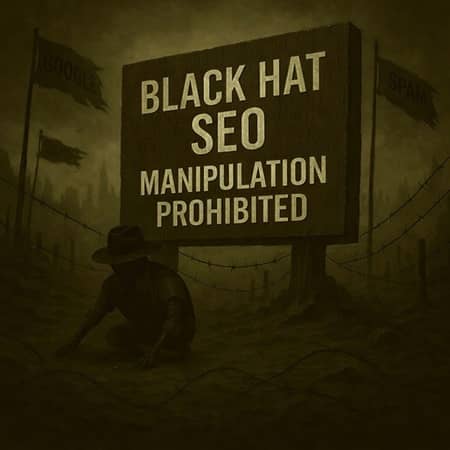
What is Black Hat SEO?
Among these techniques are cloaking, which involves presenting different content to search engines and users, keyword stuffing, which relies on the excessive repetition of keywords to influence rankings, and link buying, which aims to artificially generate backlinks in order to increase a site’s popularity.
- The Most Commonly Used Techniques in Black Hat SEO
- Why is Black Hat SEO Dangerous?
- What Are The Alternatives to Black Hat SEO?
- Useful Black Hat SEO Glossary
- Should Black Hat SEO Be Completely Banned?
The Most Commonly Used Techniques in Black Hat SEO
Here is a complete and detailed list of the most common methods used in the world of Black Hat SEO:
1. Cloaking (Content Hiding)
Displaying one type of content for indexing bots and another for users. The goal? To deceive the algorithm about the relevance of the content.
2. Keyword Stuffing
Overloading a keyword or key phrase on a web page with the aim of making it rank higher for that keyword.
Example:
“Discover our cheap shoes. Our cheap shoes are the best cheap shoes.”
3. Duplicate Content and Spinning
Copy-pasting content from another site or automatically generating content using synonyms to deceive algorithms.
4. Private Blog Networks (PBN)
Creating networks of blogs or interconnected sites to manipulate link building and artificially improve the authority of a target site.
5. Buying Backlinks
Obtaining inbound links in bulk through unethical platforms or questionable forums, often without relevant context.
6. Hidden Links
Inserting links that are invisible to users (white text on a white background, font size 0, etc.) and only visible to bots.
7. Sneaky Redirects
Displaying one page to search engines and redirecting users to another, often commercial or low-quality page.
8. Doorway Pages
Creating entry pages optimized for search engines, with no real useful content, that immediately redirect to another page.
Why is Black Hat SEO Dangerous?
Although some of these techniques may generate a temporary traffic boost, the consequences are often dramatic.
Google Is Not Fooled
Google, through algorithms such as Panda, Penguin, Hummingbird, or SpamBrain, is getting better and better at detecting these manipulations. When it identifies a Black Hat strategy, it can:
⚠️ Manually penalize a site (via Search Console)
🚫 Completely deindex it
📉 Cause it to drop drastically in the SERPs
Possible Consequences:
🔹 Loss of visibility and traffic
🔹 Drop in revenue
🔹 Damage to brand image
🔹 Difficulty regaining Google’s trust
What Are The Alternatives to Black Hat SEO?
1. White Hat SEO: A Sustainable Strategy
White Hat SEO is the exact opposite of Black Hat. It relies on transparent techniques, compliant with Google’s guidelines, and focused on the user.
Best practices include:
🔹 Creating original, informative, and well-structured content
🔹 Sound technical optimization (loading speed, tags, Hn structure…)
🔹 Natural and contextual link building
🔹 Flawless UX (user experience)
2. Grey Hat SEO: The Grey Area
Between the two extremes, some practices exist on the edge of SEO guidelines. Grey Hat is often used by experienced experts who know how to balance things without getting penalized. However, it remains risky.
Useful Black Hat SEO Glossary
| Term | Quick Definition |
|---|---|
| Cloaking | Hidden content shown differently to search engines and users |
| PBN | Network of sites used to manipulate backlinks |
| Spamdexing | Fraudulent manipulation of search engine indexing |
| Duplicate Content | Copied or repeated content across pages |
| SERP | Search Engine Results Pages |
| Google Penalty | Penalty applied by Google to a website |
Should Black Hat SEO Be Completely Banned?
For a serious business, the answer is YES. It is better to build a sustainable, gradual SEO strategy based on the real value you provide to your audience.
👉 If you are managing a site long-term (professional blog, e-commerce, showcase site, etc.), avoid these practices.
Why Black Hat SEO is a False Good idea
Black Hat SEO can look appealing in the short term, but it creates more problems than it solves.
Quick gains are short-lived and the risks of penalties or loss of visibility are high. By favouring non-compliant techniques, you put your site’s credibility, your revenue and your brand image at risk.
A sustainable SEO strategy, centred on the user and compliant with search engine guidelines, delivers stable results and lasting growth of your online visibility.
From theory to concrete visibility
Discover what Black Hat SEO is, its main techniques, the risks of Google penalties, and how to adopt a sustainable and effective SEO strategy. The next is applying them to your site and market.
- Clear explanations, no needless jargon
- Direct application to your sector
- An action plan adapted to your situation
One method, results, verifiable reviews
Here is how I work on black Hat SEO, and what my clients say about it.
What is Black Hat SEO?
Here is a complete and detailed list of the most common methods used in the world of Black Hat SEO:
The Most Commonly Used Techniques in Black Hat SEO
Here is a complete and detailed list of the most common methods used in the world of Black Hat SEO:
Why is Black Hat SEO Dangerous?
Although some of these techniques may generate a temporary traffic boost, the consequences are often dramatic.
Let’s talk about your visibility
 17+ years of SEO
I am SeoYass, an SEO expert with over 17 years of experience. I have worked with small and medium-sized businesses, successfully completing more than 350 projects.
Passionate about local SEO, I continue to learn and refine my strategies to deliver the best performance for my clients.